 |
 |
 |
 |
 |
 |
 |
 |
 |
 |
 |
 |
 |
 |
 |
 |
 |
 |
 |
©Kirton News 2026
Meet The Locals
This month we are talking to Carl from Oakwood House Independent School.
For just over two years, Oakwood House Independent School has been proud to call the former nursing home at Woodlands Court in Kirton our home.
As a school supporting children and young people with special educational needs, we are very aware that becoming part of an established local community is important. We would therefore like to take this opportunity to say a heartfelt thank you to the people of Kirton and the surrounding area for welcoming, accepting and supporting our school and our pupils.
Our pupils have a wide range of special educational needs, and for some, being part of a community can be particularly meaningful. We want Oakwood House to be more than simply a school located in Kirton. We would like it to become a positive and contributing member of the wider community, building friendships, sharing experiences and finding opportunities for our pupils to take part in local life.
We believe that the parish magazine is a wonderful way to begin building those connections. We would love to hear from local organisations, community groups, residents and businesses who might like to work with us, whether through projects, visits, volunteering, shared activities or simply opportunities for our pupils to learn more about the community around them.
The History of Oakwood House
We are also keen to discover more about the history of the building itself.
We understand that Oakwood House was built by the Dennis family and that, before becoming our school, the building had a long history as a nursing and care home. We would love to piece together that history and create a timeline celebrating the people and stories connected with the building over the years.
Perhaps you worked at Oakwood House or the former nursing home. Perhaps a parent, grandparent, relative or friend received care there. Maybe you remember the Dennis family, the building being constructed, changes that were made over the years, or simply have photographs, documents or stories that you think might help us understand its past. We would particularly love to hear from anyone who has a memory or connection to Oakwood House.
Our aim is to gather these memories and, where possible, create a record of the building’s history for the benefit of both the school and the local community. We would be delighted to speak with anyone who can help us fill in the gaps, identify people in old photographs or tell us stories about life at Oakwood House.
We hope that, by learning more about the building’s past, we can also play our part in its future.
Oakwood House has already become a special place for our pupils, and we would love to build on that by developing strong and lasting links with the community around us.
If you have memories, photographs, documents or stories about Oakwood House, or if you would like to explore ways in which you or your organisation could work with the school, we would be very pleased to hear from you.
Please get in touch with Oakwood House Independent School – we would love to hear your story.
Thank you once again to everyone in Kirton who has welcomed us over the past two years. We look forward to becoming an increasingly active part of this wonderful community and to discovering more about the history of the place we are now fortunate enough to call home.
For more details please contact: info@oakwoodhouse.school
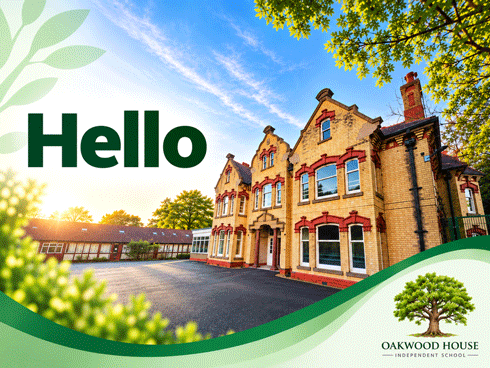
107 Endeavour FM celebrates 10 years of serving Boston Borough
107 Endeavour FM is celebrating a decade on the airwaves this August, marking 10 years since it launched on FM on 22 August 2016.
Its roots stretch back to Stump Radio broadcasts in 2006 and the launch of Endeavour Online in 2009, before securing a permanent FM licence in 2016 established Endeavour FM as Boston Borough’s full-time community radio station.
Run entirely by volunteers, the station today has around 35 people and reaches up to 9,500 listeners each week. Its entire programme schedule is created and presented by its own volunteers, with shows broadcast live from its studios in Boston except when broadcasting live from elsewhere, such as its Boston United commentary.
Alongside music and entertainment, Endeavour FM provides local information, daily travel and weather bulletins and its Community Guide, while striving to be a beacon of positivity for the town.
Developing local people has been central to the station throughout its history. Former volunteers have gone on to study journalism and radio production at university, join student radio and secure roles with the BBC and commercial radio stations, while others have continued their broadcasting journeys elsewhere. The station also works with local schools and Boston College, providing work experience and opportunities for young people.
Its work has received wider recognition, with a young presenter shortlisted in the Young Audio Awards, a presenter winning Gold for Sage Person of the Year at the Community Radio Awards, and another taking Bronze for Entertainment Show of the Year. The station and individual volunteers have also received local awards, including recognition for services to the town and wider community.
Endeavour FM has also been a longstanding champion of local music, recording more than 13,000 plays of tracks by local and regional artists since its FM launch, alongside live acoustic performances, support for local gigs and its former regular open mic night.
Its connection with local sport stretches back even further, with volunteers providing live Boston United commentary every season since 2009, initially online before the coverage also moved onto FM in 2016.
Away from the studio, Endeavour FM has become a familiar presence across Boston Borough, providing outside broadcasts, public address and compering at community events, festivals and public celebrations, while working with local charities, businesses, schools and community organisations. Its annual Christmas competition sees dozens of prizes donated by local businesses, while a special 24-hour live broadcast raised more than £1,000 for local charities.
Recent listener research demonstrates the impact of this local focus, with seven in ten listeners saying they have acted on information heard on Endeavour FM, including attending events, supporting businesses and changing travel plans.
One particularly memorable moment came when His Majesty King Charles III, then The Prince of Wales, visited the studios and met volunteers during a visit to Boston.
Station Director Dylan Taylor said: “Reaching ten years on FM is an incredible milestone and one that we are immensely proud of. When we launched on FM in 2016, our ambition was simple: to give Boston Borough a radio station it could truly call its own. Ten years later, I’m proud to say that’s exactly what our volunteers have built together.
“We’ve been privileged to give local people a platform, help launch broadcasting careers, champion local musicians, support charities, businesses and community organisations, and celebrate everything that’s great about Boston Borough. None of it would have been possible without our volunteers, supporters and, most importantly, our listeners.”
Far from slowing down as it reaches its milestone, Endeavour FM continues to go from strength to strength, with its tenth year proving a record-breaking year for outside broadcasts, promotion of local events, competitions and social media engagement.